GFC Hair Treatment in Mumbai

GFC Hair Treatment in Kharghar, Navi Mumbai
Hair thinning, excessive hair fall and loss of hair density can occur for many reasons. When active hair follicles are still present, GFC Hair Treatment (Growth Factor Concentrate) may be considered as part of a personalised hair-loss management plan.
At Dr. Gunjan Gangaraju’s clinic in Kharghar, Navi Mumbai, GFC treatment uses growth factors prepared from the patient's own blood and administered to targeted areas of the scalp. The treatment is designed to support existing hair follicles and may help improve hair density and reduce hair shedding in appropriately selected patients.
Because hair loss has many possible causes, a proper hair and scalp assessment is recommended before starting GFC treatment.
Looking for GFC Hair Treatment in Kharghar or Navi Mumbai? Consult Dr. Gunjan Gangaraju for a personalised hair-loss assessment and treatment plan.
What Is GFC Hair Treatment?
GFC stands for Growth Factor Concentrate. It is a regenerative hair treatment in which growth factors are prepared from a patient's own blood and administered into areas of the scalp affected by hair thinning.
Blood contains platelets that release several growth factors involved in tissue repair and cellular signalling. GFC preparation is designed to isolate and concentrate these growth factors for therapeutic use.
When used for suitable types of hair loss, GFC may help support existing follicles and improve the environment for healthy hair growth.
GFC cannot create completely new hair follicles and should not be considered a guaranteed cure for every type of hair loss.
How Does GFC Treatment Work for Hair Loss?
Hair follicles can gradually become smaller and produce thinner, shorter strands, particularly in pattern hair loss.
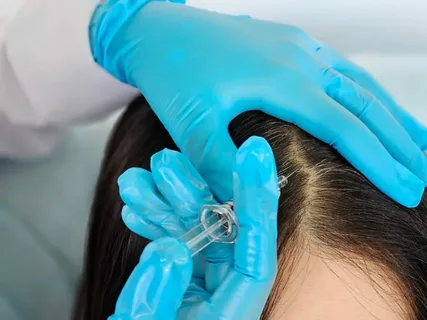
GFC treatment delivers concentrated growth factors to selected areas of the scalp. Depending on the individual's condition, this may help:

Support weakened hair follicles
Reduce excessive hair shedding
Improve the appearance of hair density
Support the natural hair-growth cycle
Improve the quality of existing hair
Complement other medically recommended hair-loss treatments
Results vary according to the cause and stage of hair loss, follicle activity, age, overall health and individual response.
Who May Be Suitable for GFC Hair Treatment?
GFC may be considered for men and women experiencing certain forms of hair thinning or progressive hair loss.
Potential candidates may include people with:
Early-Stage Hair Thinning
People who have started noticing reduced hair density or progressive thinning may be evaluated to determine whether GFC is suitable.
Male Pattern Hair Loss
Men experiencing thinning around the hairline, crown or top of the scalp may be candidates when viable follicles are still present.
Female Pattern Hair Loss
Women experiencing widening of the hair part, reduced volume or gradual thinning may be evaluated for GFC after identifying possible underlying causes.
Increased Hair Shedding
Hair shedding can occur due to several factors. A clinical assessment is important to determine the cause and whether GFC has a role in treatment.
Reduced Hair Density
Patients who still have active follicles but notice that their hair appears thinner or less dense may be considered for regenerative hair treatments such as GFC.
What Happens During a GFC Hair Treatment Session?
GFC treatment generally involves the following steps:
1. Hair and Scalp Assessment
Your scalp, hair-loss pattern, medical history and previous treatments are evaluated. Additional investigations may be advised when an underlying medical or nutritional cause is suspected.
2. Blood Collection
A small quantity of blood is collected from your arm.
3. GFC Preparation
The collected blood is processed using a specialised system designed to obtain a concentrated preparation containing growth factors.
4. Scalp Application
The prepared GFC is administered into selected areas of the scalp where thinning or reduced hair density is present.
5. Post-Treatment Care
Aftercare instructions are provided based on your scalp condition and treatment protocol.
The exact procedure and treatment plan can vary between patients.
What Are the Potential Benefits of GFC for Hair?
For appropriately selected patients, potential advantages may include:
Uses a preparation derived from the patient's own blood
Minimally invasive treatment
Usually involves minimal downtime
Targets areas affected by hair thinning
May help reduce hair shedding
May support existing hair follicles
May improve hair density in responsive patients
Can be incorporated into a comprehensive hair-loss treatment plan
GFC results develop gradually, and outcomes differ from person to person.
How Many GFC Sessions Are Needed for Hair?
There is no fixed number of GFC sessions suitable for everyone.
The recommended treatment schedule depends on factors such as:
Cause of hair loss
Severity of thinning
Duration of hair loss
Condition of existing follicles
Previous hair treatments
Individual response to treatment
Overall treatment goals
After assessing your scalp and hair-loss pattern, Dr. Gunjan Gangaraju can recommend an appropriate treatment schedule.
How Long Does GFC Take to Show Results?
GFC does not produce instant hair growth.
Hair follicles follow a natural growth cycle, so visible changes take time. Some patients may initially notice a reduction in excessive shedding, followed by gradual changes in hair quality or density.
Visible improvement may take several months and varies considerably between individuals.
Follow-up assessments help evaluate progress and determine whether additional or maintenance treatment is appropriate.
Is GFC Hair Treatment Permanent?
GFC should not be considered a permanent cure for progressive hair loss.
Conditions such as androgenetic alopecia can continue to progress because of genetic and hormonal influences. Some patients may therefore require ongoing hair-loss management or maintenance treatment.
The objective is to develop an appropriate long-term strategy based on the cause and stage of your hair loss.
GFC vs PRP for Hair: What Is the Difference?
Both GFC and PRP (Platelet-Rich Plasma) are blood-derived treatments used in hair-loss management, but their preparation methods differ.
PRP Hair Treatment
PRP involves processing the patient's blood to obtain plasma with a concentrated level of platelets. These platelets subsequently release growth factors.
GFC Hair Treatment
GFC preparation is designed to obtain a concentrated growth-factor formulation from the patient's own blood using a specific processing system.
Which Is Better: GFC or PRP?
There is no single treatment that is automatically better for every patient.
The appropriate option depends on factors such as:
Type of hair loss
Stage of hair thinning
Scalp condition
Follicle activity
Previous treatment response
Individual treatment goals
A professional assessment can help determine whether GFC, PRP or another hair-loss treatment is more appropriate.
GFC vs Hair Transplant: Which Treatment Do You Need?
GFC and hair transplantation serve different purposes.
GFC treatment is generally aimed at supporting existing, viable hair follicles.
A hair transplant is a surgical procedure in which follicles are moved from a donor area to areas affected by significant hair loss.
If an area has advanced baldness and functioning follicles are no longer present, regenerative treatments alone may not provide the desired improvement.
A scalp and hair assessment can help determine which treatment pathway is appropriate.
Why Is Hair-Loss Diagnosis Important Before GFC?
Hair loss is not always caused by the same condition.
Possible causes include:
Male or female pattern hair loss
Nutritional deficiencies
Thyroid-related conditions
Hormonal changes
Significant stress
Recent illness
Certain medications
Scalp conditions
Autoimmune disorders
Post-pregnancy hair shedding
Identifying the underlying cause is important because GFC may not be the appropriate first treatment for every condition.
A personalised evaluation helps determine whether GFC should be considered or whether another treatment or investigation is required.
GFC Hair Treatment for Men in Kharghar
Men commonly experience progressive thinning around the hairline, temples and crown due to androgenetic alopecia.
When viable follicles remain, GFC may be considered as part of a personalised treatment plan aimed at supporting existing hair and managing progressive thinning.
Seeking an assessment during the earlier stages of hair loss may provide more treatment options than waiting until advanced baldness develops.
GFC Hair Treatment for Women in Kharghar
Hair loss in women can appear differently from male pattern baldness.
Common concerns include:
Widening hair part
Reduced ponytail volume
Increased hair shedding
Diffuse thinning
Reduced density over the top of the scalp
Hormonal, nutritional and medical factors may also contribute to female hair loss.
A detailed assessment helps identify possible causes and determine whether GFC is suitable as a standalone or complementary treatment.
Is GFC Hair Treatment Painful?
GFC involves injections into selected areas of the scalp, so mild discomfort or sensitivity can occur during treatment.
Some people may experience temporary tenderness, redness or minor swelling afterward.
Your clinician will explain what to expect and provide appropriate aftercare instructions.
Is There Downtime After GFC Hair Treatment?
GFC is generally performed as an outpatient procedure and typically requires minimal downtime.
Most patients can resume routine activities relatively quickly, although certain hair products, scalp treatments or strenuous activities may need to be avoided temporarily.
Follow the specific post-treatment instructions provided by your clinician.
Why Choose Dr. Gunjan Gangaraju for GFC Hair Treatment in Kharghar?
Dr. Gunjan Gangaraju (MBBS, IFAAM, FCGP) is an aesthetic physician with experience in aesthetic and regenerative treatments.
At her clinic in Kharghar, Navi Mumbai, hair treatment begins with an assessment of the individual's hair-loss pattern rather than recommending the same procedure for every patient.
Patients considering GFC treatment can receive:
Detailed hair and scalp assessment
Personalised treatment planning
Evaluation of the possible cause of hair loss
GFC and other advanced hair-treatment options
Guidance on realistic treatment expectations
Follow-up according to treatment response
The aim is to determine whether GFC is appropriate for your individual hair-loss condition and develop a personalised management plan.
GFC Hair Treatment Near You in Kharghar, Navi Mumbai
If you are experiencing hair thinning or excessive hair fall and are searching for GFC Hair Treatment near you in Kharghar or Navi Mumbai, you can consult Dr. Gunjan Gangaraju for a personalised assessment.
Clinic Address:
First Floor, Shop No. 74–77, Chaturbhuj HSG, Plot No. 61, Sector 21, Kharghar, Navi Mumbai – 410210
Call:
An initial consultation can help identify the possible cause of your hair loss and determine whether GFC or another treatment option is suitable.
Frequently Asked Questions About GFC Hair Treatment
GFC, or Growth Factor Concentrate, is a treatment that uses a preparation derived from the patient's own blood containing concentrated growth factors. It is administered to selected areas of the scalp to support existing hair follicles.
GFC may help support hair follicles, reduce shedding and improve hair density in appropriately selected patients. Results depend on the type and stage of hair loss and individual response.
People with early-stage thinning, pattern hair loss or reduced hair density may be considered for GFC when viable hair follicles remain. A clinical assessment is necessary to determine suitability.
GFC relies on existing viable follicles. It cannot reliably create new follicles where functioning hair follicles are no longer present.
Neither treatment is universally better. GFC and PRP differ in their preparation methods, and the appropriate option depends on the patient's hair-loss pattern, scalp condition and treatment goals.
The number of sessions varies according to the type and severity of hair loss and individual response. A personalised treatment schedule should be determined after assessment.
Results are gradual because hair growth follows a biological cycle. Changes in shedding may be noticed before visible changes in hair density, which can take several months.
GFC does not permanently stop progressive hair-loss conditions. Depending on the underlying cause, ongoing management or maintenance treatment may be recommended.
Yes. Women with suitable types of hair thinning may be considered for GFC after an assessment of possible hormonal, nutritional, medical and genetic factors.
You can consult Dr. Gunjan Gangaraju in Sector 21, Kharghar, Navi Mumbai for a hair and scalp assessment and to determine whether GFC treatment is appropriate for your hair-loss condition.
Take the Next Step for Your Hair Health
Not every case of hair fall requires the same treatment.
If you are noticing increased hair shedding, a widening hair part, reduced density or progressive thinning, getting the underlying cause assessed is an important first step.
Consult Dr. Gunjan Gangaraju for GFC Hair Treatment in Kharghar, Navi Mumbai, and receive a personalised treatment plan based on your hair and scalp condition.
Call +91-7700960477 to book your consultation.
Our Treatments
